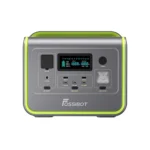
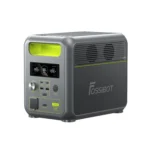
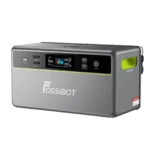
Primary keyword: FOSSiBOT F3600 Pro portable power station
The F3600 Pro is designed around a 3,840Wh LiFePO4 battery, 3,600W continuous AC output and 7,200W surge capability. Its defining feature is the balance between a large base battery and the option to add up to two FB3840 expansion batteries. That makes it particularly relevant to extended outages, RV use and demanding workshop loads.
Maximise Savings, Find Your Ideal Energy Combination
FOSSiBOT lists the F3600 Pro as expandable from its 3,840Wh base battery to 11,520Wh with two compatible FB3840 expansion batteries. These are storage-capacity options, not guaranteed electricity-bill savings. Actual results depend on local tariffs, usage and whether you shift charging to off-peak hours or solar.
| Configuration | Battery Capacity | Expansion Batteries |
|---|---|---|
| F3600 Pro base unit | 3,840Wh | None |
| F3600 Pro + 1 × FB3840 | 7,680Wh total | 1 × FB3840 |
| F3600 Pro + 2 × FB3840 | 11,520Wh total | 2 × FB3840 |
Capacity totals follow the manufacturer-listed base capacity and expansion limit. Usable energy and runtime vary with conversion losses, load and conditions. Confirm regional compatibility before purchasing expansion batteries.
Standard Packing List
Source: FOSSiBOT EU official F3600 Pro product page.
- FOSSiBOT F3600 Pro power station
- AC charging cable
- Car charging cable
- XT90 solar charging cable
- Leather handle sheath
- Cable storage bag
- Portable flashlight
- USB cable and user manual
- F3600 Pro user manual
Package contents can vary by region or bundle. A solar panel or other optional accessory is not assumed included unless explicitly listed in the selected bundle.
Official specifications
| Specification | Official figure |
|---|---|
| Capacity | 3,840Wh |
| Expansion | Up to 11,520Wh with two FB3840 batteries |
| Battery | LiFePO4, 6,500+ cycles (to 50% original capacity) |
| AC output | 3,600W pure sine wave |
| Surge | 7,200W |
| Solar input | 2,000W max., 12–160V |
| AC input | 2,200W max. on the published main specification |
| AC + solar | Up to 4,200W on the EU configuration |
| UPS | Switchover within 10ms |
| Connectivity | Wi-Fi + Bluetooth |
| Outputs (EU version) | 13: 3 × AC, 3 × USB-C PD20W, 1 × USB-C PD100W, 2 × USB-A 18W, 12V/25A, 12V/10A, 2 × 12V/3A DC5521 |
| Generator input | 1,100W max. |
| Car charger input | 12/24V, 10A max. |
| Operating temperature | Discharging -10 to 40 °C, charging 0 to 40 °C |
| Noise | 45–65dB at 1 m, depending on load |
| Certifications | FCC, CE, PSE, RoHS, UN38.3, MSDS |
| Warranty | 5 years total (2+3) |
| Weight | 42kg |
| Dimensions | 609 × 321 × 475.5mm |
Full usage reference
| Appliance / Device | Typical Power |
|---|---|
| CPAP | 40W |
| Drone | 40W / 40Wh example |
| Light | 40W |
| Computer | 60W |
| Car mini refrigerator | 60W |
| Fan | 70W |
| Outdoor speaker | 100W |
| Small inflation pump | 120W |
| Car vacuum cleaner | 120W |
| Refrigerator | 200W |
| Projector | 300W |
| Portable air conditioner | 500W |
| Microwave oven | 700W |
| Coffee maker | 700W |
| Electric kettle | 800W |
| Juicer | 900W |
| Air conditioner | 1,000W |
| Water pump | 1,100W |
| Circular saw cutter | 1,200W |
These wattages are typical reference values, not exact figures for every model. The actual appliance label and startup demand remain the controlling values.
FOSSiBOT’s runtime formula is capacity in Wh × 0.85 ÷ the device’s power in W. Applied to the 3,840Wh base unit, it gives roughly 81 hours for a 40W CPAP, 16 hours for a 200W refrigerator, 4.7 hours for a 700W microwave (FOSSiBOT’s own example), 4 hours for an 800W kettle and 2.7 hours for a 1,200W circular saw. Adding FB3840 batteries scales these figures: 7,680Wh roughly doubles them and 11,520Wh roughly triples them. These are theoretical lab calculations, not guaranteed runtimes.
What makes the Pro useful
The 3,600W inverter leaves substantial headroom for appliances that would challenge smaller stations. FOSSiBOT lists appliances such as an air conditioner, microwave oven, refrigerator, coffee maker and power tools among the loads it is intended to run. The important rule is that the total simultaneous AC load must remain within the 3,600W continuous rating.
Runtime planning
The FOSSiBOT formula (capacity in Wh × 0.85 ÷ load in W) gives about 16 hours for a 200W air cooler and about 9.9 hours for a 330W combined load such as a CPAP, laptop, refrigerator, lights and fan from the 3,840Wh base unit. These figures ignore the unit’s own standby consumption, so treat them as theoretical estimates, not guaranteed runtimes.
Expansion changes the planning equation
One FB3840 raises the stored energy to 7,680Wh and two raise it to 11,520Wh. Expansion is useful when the limiting factor is duration rather than instantaneous output. It does not turn the inverter into a higher-wattage unit: the base continuous AC limit remains the critical consideration for simultaneous loads.
Home and RV use
At home, the F3600 Pro can be organised around refrigeration, networking, lighting, computers and selected high-power appliances. In an RV, the combination of AC, USB and 12V outputs is useful because not every load needs to pass through the AC inverter. That can make a daily energy plan more efficient.
Charging
For the EU version, FOSSiBOT lists up to 2,200W AC input, 2,000W solar input (12–160V, under 20A) and up to 4,200W combined AC + solar input, which gives a full charge in about 1.5 hours. AC alone takes about 2 hours, solar alone about 2 hours in ideal sunshine, and a 1,100W generator about 3.5 hours. The US version has different charging limits, so these figures apply to the EU model. For solar, use identical panels, and note that with SP420 panels four in series is the recommended maximum to stay under 160V.
UPS and smart control
FOSSiBOT states that the UPS switches over within 10ms. Wi-Fi and Bluetooth connectivity allow monitoring and control through the app. These features are useful during an outage because the remaining battery level and active load can be checked without repeatedly moving the unit or changing the connected appliances.
Strengths and trade-offs
The main strengths are capacity, high continuous output, expansion, multiple output types and smart monitoring. The main trade-off is physical size: 42kg is not a lightweight camping battery. The model is therefore better thought of as movable home/RV backup than as a simple portable power bank.
Safety and maintenance
Keep ventilation openings clear, keep the station away from moisture, use the correct charging configuration, and respect the regional voltage and outlet differences. Do not exceed the continuous AC rating simply because the surge number is higher. Motor-driven appliances should be evaluated for startup demand.
Bottom line
The F3600 Pro is strongest when a user needs both high output and a meaningful energy reserve. Its long usage table makes it easier to build a realistic load plan before purchase. If your requirements are mostly phones, laptops and lights, a smaller model is easier to justify; if the plan includes refrigeration, cooking, tools or longer outages, the F3600 Pro becomes much more relevant.