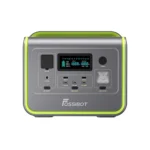
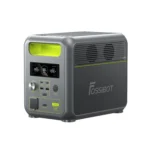
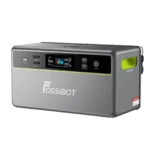
Primary keyword: FOSSiBOT F3600 portable power station
The FOSSiBOT F3600 deserves separate treatment from the F3600 Pro. Both sit in the 3,840Wh class, but the F3600 has its own published input, output and port configuration. This guide therefore evaluates the model on its own numbers rather than borrowing the Pro’s features.
Standard Packing List
Accessory note: This model is supplied with accessories, but a complete model-specific standard packing list could not be verified on the official manufacturer page reviewed for this update. To avoid misleading readers, individual accessory names and quantities are not guessed. Confirm the exact included accessories for the regional model and selected bundle with FOSSiBOT or the seller before ordering. Optional solar panels, expansion batteries, cables, or bundle-only items should not be assumed included unless explicitly listed.
Specifications
Source note: the F3600 is no longer shown in the FOSSiBOT EU product menu. The figures below come from earlier FOSSiBOT F3600 material, the FOSSiBOT F3600 Pro comparison and retailer listings (for the AC input steps). Confirm them against the manual for your unit before buying.
| Specification | Figure |
|---|---|
| Capacity | 3,840Wh |
| Battery | LiFePO4 |
| Battery pack voltage | 48V |
| AC output | 3,600W rated, pure sine wave |
| Peak output | 7,200W |
| AC frequency | 50/60Hz switchable |
| AC input | 2,200W max. in five adjustable steps (400W, 800W, 1,200W, 1,600W, 2,200W) |
| Combined AC + solar input | 4,200W max. |
| Solar input | 2,000W max., 12–160V |
| USB-C | 3 × PD20W + 1 × PD100W |
| USB-A | 2 × QC3.0 18W |
| 12V outputs | 12V/10A, 12V/25A and 2 × 12V/3A |
| Cycle life | 6,500+ cycles |
| Weight | 42kg |
| Dimensions | 609 × 321 × 475.5mm |
| Expansion | None (single unit) |
| App control | Not supported, according to the FOSSiBOT F3600 Pro comparison |
Capability overview
| Use Category | Capability |
|---|---|
| Household appliances | Up to 3,600W rated AC output (7,200W peak) |
| Professional tools | AC output available up to the rated limit |
| USB devices | PD20W / PD100W / QC3.0 outputs |
| 12V DC equipment | 12V/10A, 12V/25A and 12V/3A outputs |
| Solar charging | Up to 2,000W input |
The appliance list is intentionally preserved as a capability table because the official product information does not publish the same long appliance-by-appliance runtime chart used for some other FOSSiBOT models.
Where the F3600 fits
A 3,840Wh battery is substantial enough for extended essential-load backup, while the 3,600W headline inverter provides room for demanding equipment. FOSSiBOT lists 3,600W continuous output with a 7,200W peak, but keep real loads well within the continuous rating and confirm the figures for your exact regional version.
Why output ports matter
The F3600 is not only an AC inverter. Its USB-C and 12V outputs allow compatible devices to bypass unnecessary AC conversion. A laptop, phone, camera, light or 12V accessory can often be supplied directly through the appropriate port. This matters because a long outage is an energy-management problem, not merely an output-wattage problem.
Runtime planning
A useful planning formula is battery capacity multiplied by an efficiency factor and divided by the average load. For example, an illustrative 200W load would start from the 3,840Wh capacity, but actual duration depends on conversion losses, temperature, battery condition and whether the appliance cycles. A refrigerator is especially variable because its compressor is not continuously drawing its nameplate power.
Charging and solar
The published 2,000W maximum solar input is one of the F3600’s major advantages. Solar output should not be confused with guaranteed production: sunlight, panel temperature, orientation and system limits determine the actual input. AC charging is more predictable for preparing the unit before an outage.
Who benefits most?
The F3600 is aimed at users who need long-duration energy and substantial output but do not necessarily need the newer expansion-oriented Pro configuration. It can suit home backup, workshops and outdoor work. At 42kg, however, it is best moved with planning rather than treated as a grab-and-go battery.
Safety and maintenance
Use the exact regional version, keep the station ventilated and dry, inspect cables, and stay within the published input and output limits. Large loads should be connected deliberately, especially motors, pumps and compressors that can create startup surges.
Final assessment
The F3600’s appeal is its combination of a 3,840Wh energy reserve, high AC capability, extensive DC outputs and strong solar input. Its best use is sustained backup or field power where several classes of equipment need energy. The key buying check is not the headline wattage alone; it is whether the exact version’s output, ports and charging system match your real load list.