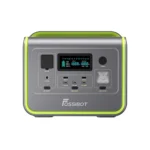
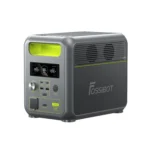
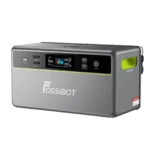
Primary keyword: FOSSiBOT F2400 portable power station
The FOSSiBOT F2400 sits in a useful middle-to-large range: 2,048Wh of LiFePO4 storage and 2,400W of pure-sine AC output. It is large enough for meaningful home backup while remaining considerably smaller than the 3,840Wh and 5,222Wh systems. The most useful way to judge it is through typical appliance loads.
Standard Packing List
Source: FOSSiBOT official EU F2400 product page.
- FOSSiBOT F2400 2400 W portable power station
- Power cord (1.5 m)
- Solar charging cable (1 m)
- Vehicle charging cable (1 m)
- User manual
This list follows the official EU page; contents may differ by region or bundle. A solar panel is not assumed included unless the selected bundle explicitly includes it.
Official specifications
| Specification | Official figure |
|---|---|
| Capacity | 2,048Wh |
| Battery | LiFePO4 |
| Lifecycle | 4,000+ cycles to 80% original capacity |
| AC output | 2,400W |
| Surge | 4,800W |
| Inverter | Pure sine wave |
| AC input | 1,100W max. |
| Solar input | 500W max. |
| AC + solar | About 1.5 hours |
| AC charging (1,100W) | About 2 hours |
| Solar charging (500W) | About 4 hours (strong sunshine, ideal orientation) |
| Max. simultaneous input | 1,600W (AC + solar) |
| Operating temperature | Discharging -10 to 40 °C, charging 0 to 40 °C |
| Warranty | 5 years |
| UPS | Supported |
| Weight | 22kg |
| Dimensions | 386 × 284 × 321mm |
Appliance runtime estimates
The figures below are estimates based on the FOSSiBOT formula (capacity in Wh × 0.85 ÷ load in W). They are not manufacturer guarantees, and real runtime depends on the appliance, temperature and conversion efficiency.
| Appliance / Device | Typical Power | Estimated Runtime |
|---|---|---|
| Drone | 77W | 22.6 hours |
| Blender | 300W | 5.8 hours |
| Mini Cooler | 60W | 29 hours |
| Electric Grill | 1,100W | 1.58 hours |
| Light | 12W | 145 hours |
| 43-inch TV | 110W | 15.8 hours |
| Coffee Maker | 1,100W | 1.58 hours |
| Microwave | 700W | 2.5 hours |
| Hair Dryer | 1,600W | About 65 minutes |
| CPAP machine | 40W | 43.5 hours |
| Electric Drill | 1,080W | About 97 minutes |
| Electric Saw | 1,200W | 87 minutes |
| Lawn Mower | 1,400W | About 75 minutes |
| Electric Hammer | 1,500W | About 70 minutes |
What this table tells us
The F2400 demonstrates why battery capacity and appliance power must be considered together. A 12W light can operate for a very long period because its demand is tiny, while a 1,100W grill consumes stored energy much faster. FOSSiBOT also gives a simple calculation of capacity × 0.85 ÷ operating power, with its own examples of about 3.3 hours at 500W and about 1.7 hours at 1,000W.
Home outage use
The F2400 is best assessed against the actual power demand of the devices you plan to run. Its 2,400W continuous AC output gives substantial headroom for the listed loads, while the 4,800W surge figure is intended for startup demands rather than continuous operation.
Charging
FOSSiBOT specifies up to 1,100W AC input and up to 500W solar input. The manufacturer publishes approximately 1.5 hours for AC plus solar under its stated test conditions. FOSSiBOT also quotes about 2 hours for a full charge from AC at 1,100W and about 4 hours from 500W of solar in strong sunshine, with a combined maximum input of 1,600W. Solar charging time will vary with sunlight and panel conditions.
Regional versions
The F2400 is sold in regional configurations with different AC outlet arrangements. Lagonzy should therefore display the specification set that matches the actual regional product listing rather than assuming one outlet configuration applies worldwide.
Limitations
At 22kg, the F2400 is portable but not lightweight. High-power loads can also consume the 2,048Wh stored energy quickly. The 4,800W surge rating should not be treated as a continuous operating rating.
Maintenance and safety
Keep the station dry and ventilated, use the correct charging cables, avoid blocking cooling openings and inspect connectors regularly. Do not open the battery enclosure. Before an outage, charge the unit and confirm that the connected load remains within the appropriate continuous output limit.
Verdict
The F2400 is a useful middle ground for users who need more than a 1kWh-class station but do not need the physical scale of a 3.8–5.2kWh system. The runtime estimates make it easier to understand how the same battery behaves across low-, medium- and high-power loads.