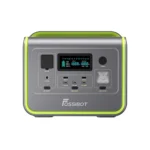
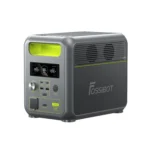
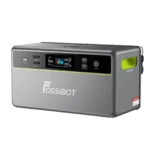
Primary keyword: FOSSiBOT F1800 portable power station
The F1800 is the model for users who want a substantial 1,024Wh battery without moving into the much heavier 2,048Wh class. Its 1,800W continuous AC output and 3,600W peak capability give it enough headroom for many everyday appliances, while its size makes it practical for camping, caravan use and selected home backup.
Standard Packing List
- FOSSiBOT F1800 portable power station (371 × 258 × 206 mm)
- AC charging cable (1.5 m)
- Solar charging cable (1 m)
- Car charging cable (1.5 m)
- Accessories bag
- User manual
As listed on the official FOSSiBOT EU product page. A solar panel is not assumed included unless the selected bundle explicitly lists it.
Official specifications
| Specification | Official figure |
|---|---|
| Capacity | 1,024Wh |
| Battery | LiFePO4 / LFP |
| Lifecycle | 4,000 cycles to 80%+ capacity |
| AC output | 1,800W |
| Peak power | 3,600W |
| AC input | 1,200W max. |
| Solar input | 500W max. |
| USB-A | 1 × 18W max. (QC3.0) |
| USB-C | 2 × 140W max. |
| Car outlet | 12V/10A |
| UPS | ≤10ms |
| Noise | About 30dB |
| Weight | 11.25kg |
| Dimensions | 371 × 206 × 258mm |
| Operating temperature | -10 to 40°C |
| Charging temperature | 0 to 40°C |
| Connectivity | Wi-Fi + Bluetooth |
| Warranty | 5 years total (2+3) |
Typical appliance power reference
These are typical reference wattages. Check the label of your own appliance, because real consumption and start-up demand vary.
| Device | Typical Power |
|---|---|
| Laptop | ~60W |
| TV | ~100W |
| Wi-Fi router | ~10W |
| Refrigerator | ~100–200W while running |
| Microwave | ~1,000W |
| Electric kettle | ~1,500W |
| Power tools | Varies by tool |
Why the F1800 works well at this size
The 1,800W continuous output is enough for many household and outdoor appliances without the weight of a 2kWh-plus system. FOSSiBOT also highlights UPS switching under 10ms, app control and 500W solar input. This makes the F1800 more than a camping battery; it can be planned as a selective backup for essential electronics.
Runtime examples
The FOSSiBOT planning formula (capacity in Wh × 0.85 ÷ load in W) applied to 1,024Wh gives these results. That produces about 8.7 hours at 100W, 2.9 hours at 300W and 1.7 hours at 500W. Those numbers illustrate energy use rather than guarantee household runtime. Compressor appliances cycle, while heating appliances usually draw close to their rated power when switched on.
Camping and caravan use
For outdoor use, the F1800’s 11.25kg weight is important. A 12V refrigerator, laptop, lighting and communication equipment can be planned around the 1,024Wh battery. Solar input up to 500W provides a way to replenish the battery during suitable daylight conditions.
Home backup and UPS
The F1800 can be used to protect selected devices such as routers, laptops and other essential electronics through its UPS function. It should not be treated as a whole-home replacement simply because the inverter can operate a powerful appliance. The battery reserve remains the limiting factor for long-duration high loads.
Charging and battery care
The manufacturer publishes fast AC charging (about 68 minutes for a full charge) and 500W solar charging (about 2 hours in strong sunshine). The EU page lists combined AC and solar input of up to 1,700W, while its FAQ describes a 1,200W total charging limit, so check the manual before planning around the higher figure. For repeated use, avoid unnecessary full-depth cycling when practical, keep the unit within its temperature limits, and use compatible charging equipment. Keep ventilation paths clear.
Who should choose it?
The F1800 is a sensible fit for users who want one station to bridge the gap between small USB-focused units and large home backup systems. It is especially attractive when portability matters almost as much as capacity.
Bottom line
The F1800’s strongest argument is balance: 1,024Wh, 1,800W output, 3,600W peak, solar input, UPS and manageable weight. The appliance table shows where it works best, while the runtime calculation explains why high-power cooking loads should be used selectively.