Physical Address
304 North Cardinal St.
Dorchester Center, MA 02124
Physical Address
304 North Cardinal St.
Dorchester Center, MA 02124

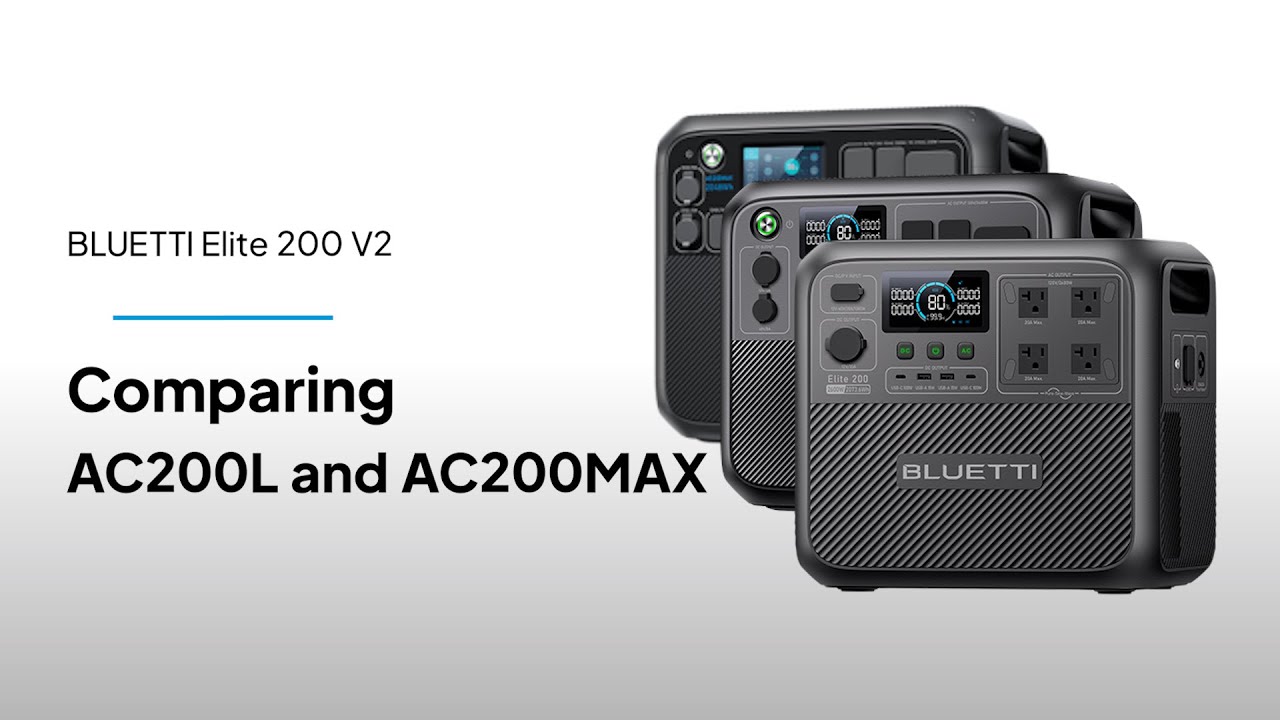
The BLUETTI AC200MAX Expandable Power Station USA model is one of the most widely adopted mid-size bluetti power station platforms for home battery backup, combining a 2048Wh LiFePO4 core with a modular expansion path.
This guide breaks down how the BLUETTI AC200MAX performs across power delivery, charging, and thermal management, along with where it fits against other options in the category.
The BLUETTI AC200MAX is built around a 2048Wh (40Ah) LiFePO4 battery pack rated at a standard voltage of 51.2VDC, paired with a pure sine wave inverter delivering 2200W of continuous output at the standard US 120V/60Hz setting, with a 4800W surge rating sustained for 100ms.
This is not a repackaged lead-acid design. The core cell chemistry is lithium iron phosphate, chosen specifically for its thermal stability and cycle longevity over lithium cobalt oxide or NMC alternatives, which is why BLUETTI positions this pack for long-term battery backup duty rather than single-season use.
The internal battery management system monitors cell voltage, pack temperature, and current draw across multiple channels simultaneously, since a single point of thermal failure in a pack this size can cascade across the remaining cells.
BLUETTI’s BMS implementation on the AC200MAX includes cell balancing circuitry that actively redistributes charge across series-connected cells during charge cycles, preventing the voltage drift that shortens pack life in lower-tier battery backup units.
| Parameter | Value |
|---|---|
| Battery capacity | 2048Wh (40Ah) |
| Battery voltage | 51.2VDC |
| Chemistry | LiFePO4 |
| Continuous AC output | 2200W |
| Surge rating | 4800W (sustained 100ms) |
| Inverter type | Pure sine wave |
| THD (Total Harmonic Distortion) | Under 3% |
| Weight | 28.1 kg (61.9 lbs) |
| Dimensions | 420 × 280 × 386.5 mm (16.5 × 11.0 × 15.2 in) |
The 2200W continuous output rating on the AC200MAX covers most household appliances without derating concerns. Refrigerators, window AC units, power tools, and small workshop equipment all fall within this envelope.
The overload logic is tiered rather than a single trip point at the US 120V setting, a load between 2200W and 2750W is tolerated for up to 2 minutes before the unit shuts the output down, while anything above 2750W trips in 8 to 10 seconds, with a rated error margin of ±30W.
The 4800W surge rating, sustained for 100ms, exists specifically for motor start loads, since compressors and induction motors draw three to five times their running current during the first few hundred milliseconds of startup.
Insufficient surge headroom trips the overcurrent protection at the moment a compressor engages, independent of whether the running load itself falls within the continuous rating.
| Load Range | Trip Behavior |
|---|---|
| 2200W – 2750W | Up to 2 minutes before shutdown |
| Above 2750W | 8–10 seconds (±30W margin) |
| Surge (motor start) | 4800W for 100ms |
Pure sine wave output is non-negotiable for anything with a switched mode power supply or a variable frequency drive, which now includes most modern electronics.
Modified sine wave inverters introduce harmonic distortion that shows up as electrical noise in audio equipment, reduced efficiency in transformers, and outright malfunction in equipment with power factor correction circuits.
The AC200MAX outputs total harmonic distortion under 3 percent, which places it within the range where sensitive electronics operate without derating or premature failure.
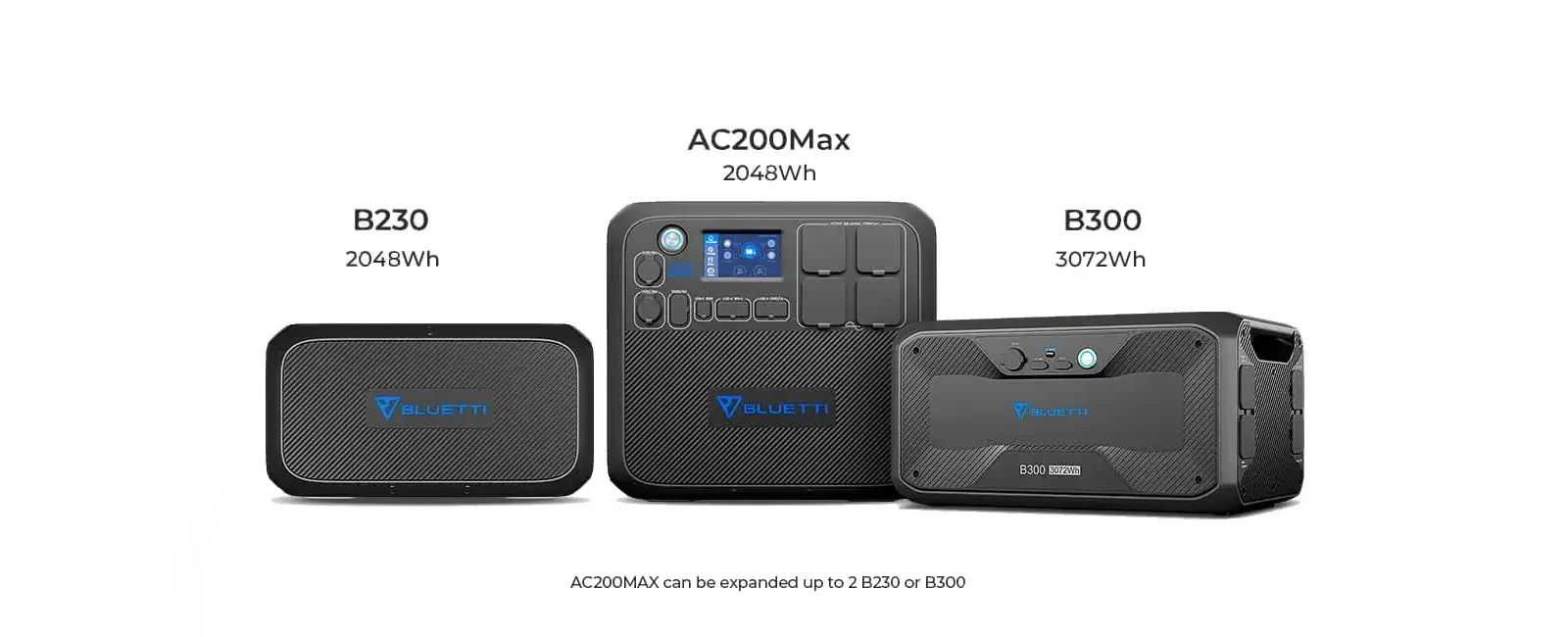
What separates this expandable power station, the BLUETTI AC200MAX, from a standard fixed-capacity unit is the pair of dedicated battery extension ports on the rear panel, each accepting either a BLUETTI B230 or a B300 external battery module.
The AC200MAX supports up to two modules simultaneously, and the two module types differ in capacity contribution: the B230 adds 2048Wh per unit, while the B300 adds 3072Wh per unit.
One B230 brings total system capacity to 4096Wh, two B230 units to 6144Wh, one B300 to 5120Wh, and two B300 units to a maximum of 8192Wh.
| Configuration | Total Capacity |
|---|---|
| Base unit only | 2048Wh |
| + 1× B230 | 4096Wh |
| + 2× B230 | 6144Wh |
| + 1× B300 | 5120Wh |
| + 2× B300 (max) | 8192Wh |
B230 adds 2048Wh per unit, B300 adds 3072Wh per unit. Module types cannot be mixed.
This distinguishes the platform from a fixed-capacity design, where total capacity is set permanently at the time of purchase.
Physically, the expansion batteries connect through a hot-swappable P090A battery expansion cable rather than a fixed internal bus.
Each cable has two control buttons at the connector one toggles the expansion battery function on and off, and the other locks or unlocks the physical connection to the AC200MAX chassis, preventing the cable from disconnecting under vibration during transport or vehicle use.
The hot-swap design permits a module to be added, removed, or replaced without powering down the master unit. Physical installation steps for the connector are documented in BLUETTI’s official support and video library.
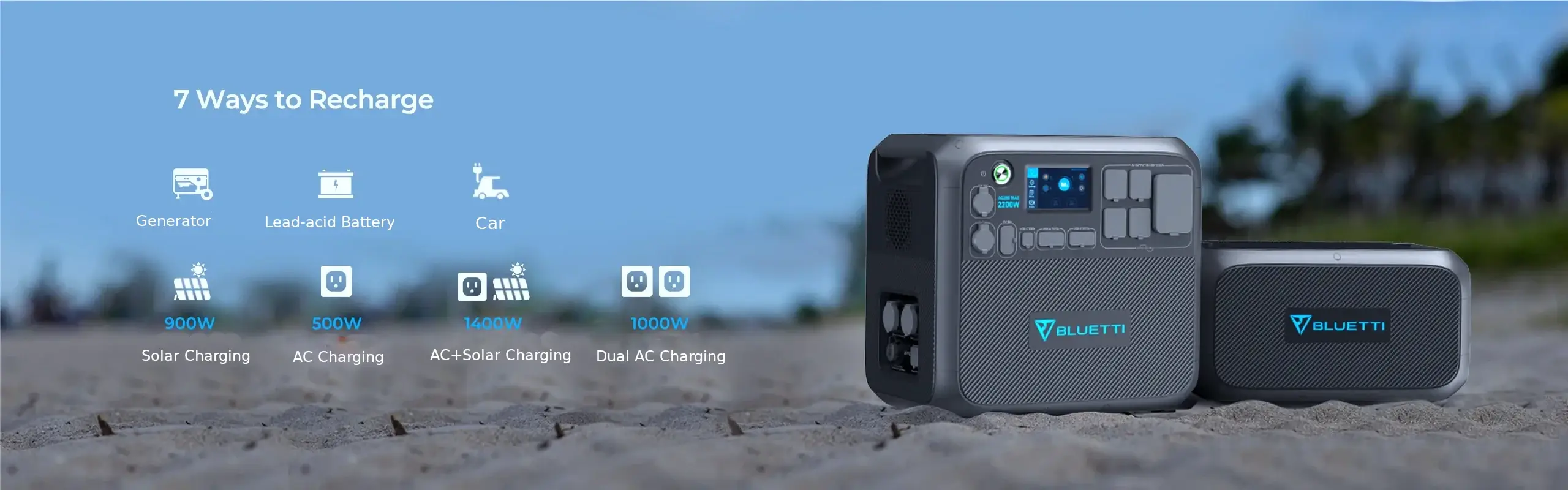
The BLUETTI AC200MAX supports five charging paths through its T500 500W AC adapter, its solar (PV) input via MPPT controller, a car cigarette lighter connection, a generator connection through the same AC input, and a lead-acid battery clamp accessory.
Charging from the wall alone via the T500 adapter takes 4.6 to 5.1 hours to reach 100 percent from empty.
Dual charging is supported in two configurations setting the DC input source to PV charges from AC and solar simultaneously up to a combined 1200W, while setting it to Others combines AC charging with a car or lead-acid battery source instead.
Both car charging and lead-acid charging are capped at 8.2A input current regardless of which of the two sources is active.
Dual-input charging allows solar to supplement wall charging as sunlight becomes available, without disconnecting one source before enabling the other.
The solar input accepts up to 900W with an open-circuit voltage range of 10 to 145V across the panel array (in series or parallel), and an MPPT voltage tracking window of 14 to 145VDC, using a single MPPT channel.
Maximum solar input current is 15.2A ±0.3A, and any current above that ceiling is simply not harvested rather than damaging the controller.
The integrated MPPT (Maximum Power Point Tracking) controller continuously adjusts the load impedance presented to solar panels to extract maximum available wattage as irradiance and panel temperature shift throughout the day.
A PWM controller by comparison loses a meaningful share of available solar harvest under partial cloud cover or temperature swings, since it lacks the impedance matching logic MPPT relies on.
| Method | Spec |
|---|---|
| AC (T500 adapter) | 500W, 0–100% in 4.6–5.1 hrs |
| Solar (single MPPT channel) | Up to 900W |
| Solar voltage window | 10–145V open-circuit / 14–145VDC MPPT tracking |
| Max solar current | 15.2A ±0.3A |
| Car / lead-acid clamp | Capped at 8.2A input |
| Max combined (AC + Solar) | 1,400W (500W + 900W) |
Sustained inverter loads generate heat that has to be dissipated without exceeding component temperature ratings on the IGBTs and the battery cells themselves.
The AC200MAX uses forced air cooling with temperature-triggered fan speed control, keeping fan noise low under light loads and ramping only when internal temperatures cross defined thresholds.
BLUETTI rates the AC200MAX for charging across 0 to 40 degrees Celsius and discharging across negative 20 to 40 degrees Celsius, with a working humidity range of 10 to 90 percent.
The hardware over-temperature protection trips at 80°C ±2 and only permits resumption once the unit cools back down to 75°C ±2. Charging outside the rated temperature window triggers the BMS to throttle or halt input current entirely, which protects cell integrity at the cost of charge speed in low-temperature conditions.
| Condition | Range |
|---|---|
| Charging temperature | 0°C to 40°C |
| Discharging temperature | -20°C to 40°C |
| Operating humidity | 10–90% |
| Over-temp shutdown trip | 80°C ±2 |
| Resumes after cooling to | 75°C ±2 |
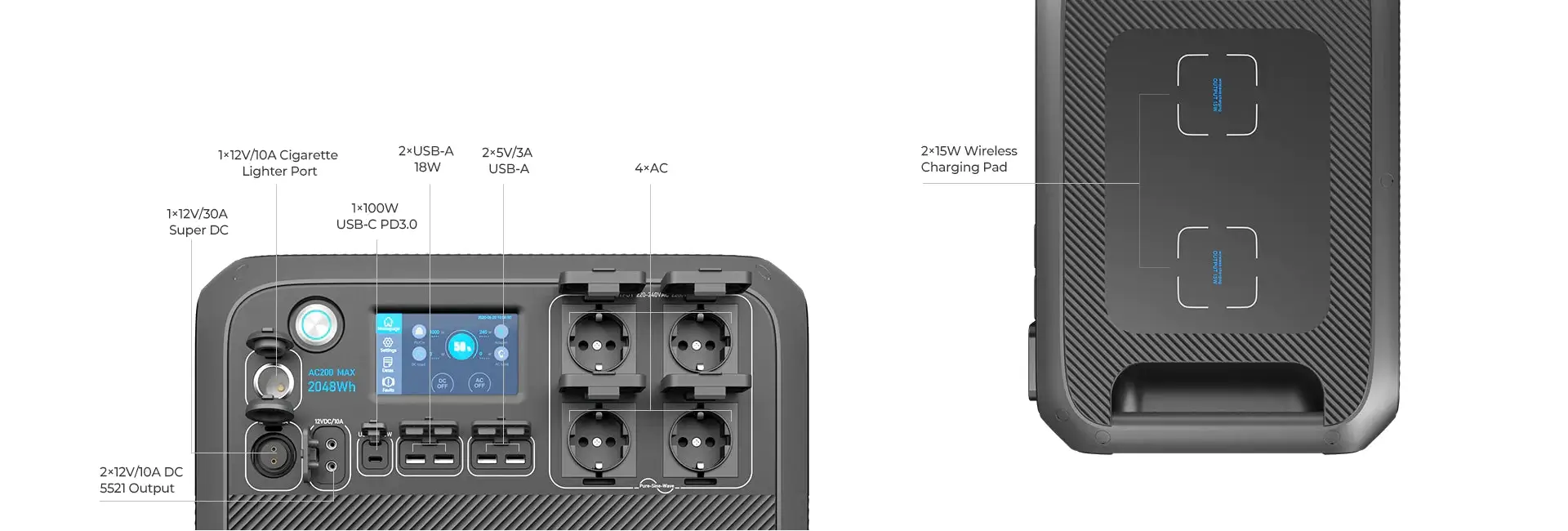
On the DC side, the AC200MAX provides a 12V/10A cigarette lighter port and two DC5521 12V/10A ports that share the same 10A current budget with the cigarette lighter port rather than each getting an independent 10A allocation any of these ports shuts off 2 seconds after crossing 145W and only recovers once the overload clears.
A separate 12V/30A RV-oriented port (NEMA TT-30 compatible via the appropriate adapter) carries its own 400W overload threshold with the same 2-second trip behavior.
All DC output ports combined are capped at 30A total. Two USB-A ports deliver a standard 5V/3A each (3A shared across both), and two USB-A quick charge ports support QC3.0 at up to 18W each.
A single USB-C port supports PD3.0 fast charging up to 100W, and two 15W wireless charging pads on the top surface support the Qi protocol for phones placed flat on the unit.
| Port | Rating | Notes |
|---|---|---|
| Cigarette lighter + 2× DC5521 | 12V/10A (shared) | Combined 10A budget |
| RV port (NEMA TT-30 compatible) | 12V/30A | 400W overload threshold |
| Total DC output cap | 30A | Independent of AC budget |
| USB-A ×2 | 5V/3A (3A shared) | |
| USB-A Quick Charge ×2 | QC3.0, 18W each | |
| USB-C | PD3.0, up to 100W | |
| Wireless charging pads ×2 | 15W each, Qi |
Running all output types concurrently draws against the same 2200W continuous AC ceiling for the AC side specifically, while DC output draws against the separate 30A DC budget described above the two budgets are independent rather than pulling from one shared number.
No power station converts stored DC energy to usable AC output at 100 percent efficiency.
BLUETTI rates the AC200MAX inverter at 90 percent efficiency, and this figure is built directly into the manufacturer’s own runtime formula rated capacity multiplied by depth of discharge (DOD, rated at 90 percent) multiplied by inverter efficiency (also 90 percent), divided by the connected load in watts, gives the estimated runtime in hours.
Applied to the base 2048Wh pack, that formula is 2048 × 0.9 × 0.9 ÷ load(W), meaning a fully charged unit delivers roughly 1659Wh of effective runtime energy against a given load rather than the full nameplate 2048Wh.
| Factor | Value |
|---|---|
| Inverter efficiency | 90% |
| Depth of Discharge (DOD) | 90% |
| Effective usable energy (base pack) | ~1,659Wh (of 2048Wh nameplate) |
| Formula | Capacity × DOD (0.9) × Efficiency (0.9) ÷ Load(W) = Runtime (hrs) |
Applying this same DOD and efficiency derating to a specific appliance load, rather than assuming the full rated Wh translates directly to output Wh, a 200W continuous load against the base pack works out to roughly 8.3 hours of runtime using BLUETTI’s own formula, not the 10.24 hours a capacity-divided-by-load calculation alone would suggest.
BLUETTI’s own published reference points follow this logic: a 90W refrigerator runs roughly 17 to 19 hours, an 80W set of electronic tools runs roughly 19 to 20 hours, and a 200W slow cooker runs roughly 8 to 9 hours on the base pack.
| Load | Estimated Runtime |
|---|---|
| 90W refrigerator | 17–19 hours |
| 80W electronic tools | 19–20 hours |
| 200W slow cooker | 8–9 hours |
| 200W continuous (formula-calculated) | ~8.3 hours |
| 1000W microwave | ~1.65 hours |
For home battery backup applications specifically the core use case for this bluetti power station the relevant metric isn’t peak wattage but sustained runtime against a realistic household load profile during an outage.
A typical household running a refrigerator, a handful of LED lights, a modem and router, and occasional phone charging draws an average load in the 250 to 350W range.
Against the base 2048Wh AC200MAX capacity and applying BLUETTI’s own 90 percent DOD and 90 percent inverter efficiency figures, this yields roughly 4.7 to 6.6 hours of backup runtime, extendable to 9.4 to 13.3 hours with a single B230 module (4096Wh total) or 11.7 to 16.4 hours with a single B300 module (5120Wh total), and up to 21 hours with the full two-module B300 expansion at 8192Wh.
| Configuration | Total Capacity | Estimated Runtime (250–350W load) |
|---|---|---|
| Base unit | 2048Wh | 4.7–6.6 hours |
| + 1× B230 | 4096Wh | 9.4–13.3 hours |
| + 1× B300 | 5120Wh | 11.7–16.4 hours |
| + 2× B300 (max) | 8192Wh | Up to 21 hours |
A fixed base capacity with no expansion path sets a permanent runtime ceiling at the time of purchase.
The AC200MAX’s expandable architecture separates the initial capacity from the maximum achievable capacity, with additional modules attachable after purchase.
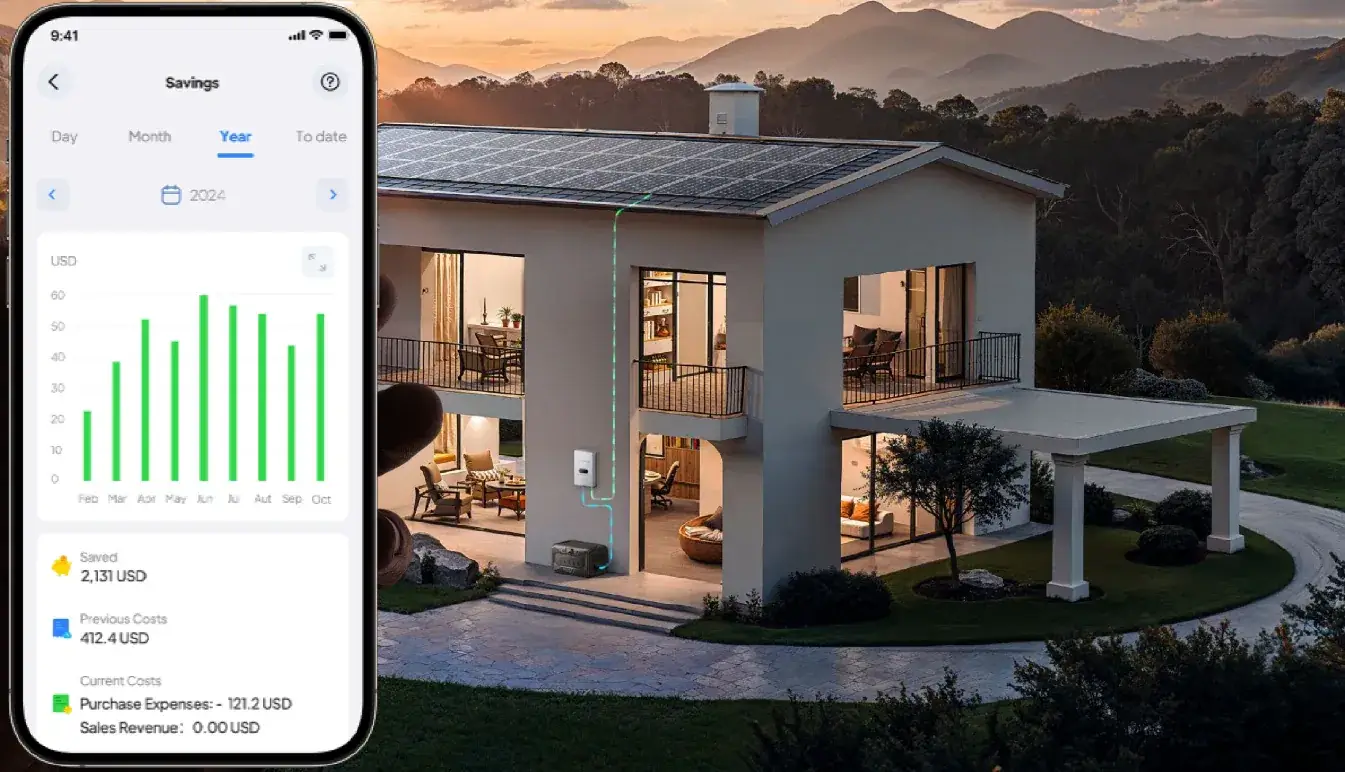
BLUETTI’s companion app connects to the AC200MAX over Bluetooth, with a rated wireless connection range of 10 meters (32.8ft) for general monitoring and control.
Firmware updates for the ARM, DSP, HMI, and BMS subsystems are delivered over the air through this same Bluetooth link, but BLUETTI specifies keeping the phone within 5 meters (16.4ft) of the unit specifically during an update to avoid a dropped connection mid-flash.
The app surfaces the same real-time voltage, current, power, temperature, and state-of-charge data the onboard touchscreen shows, along with fault history and hardware version information for the BMS, DSP, ARM, and HMI modules.
Because updates and monitoring both route through Bluetooth rather than WiFi, remote monitoring is limited to short range rather than over the internet.
At 28.1kg (61.9lbs) and 420 x 280 x 386.5mm (16.5 x 11.0 x 15.2in) for the base unit, this bluetti power station sits in a middle tier of portability, moveable by a single person via its integrated handles but not designed for backpack carry.
This weight is a direct consequence of the LiFePO4 cell density tradeoff LiFePO4 offers superior cycle life and thermal stability compared to NMC chemistry but at a lower energy density per kilogram, so equivalent capacity in LiFePO4 form factor weighs more than an NMC equivalent.
This tradeoff reflects the product’s positioning toward reliability-focused battery backup use rather than ultralight backpacking applications, where a different set of priorities applies.
Against competing power stations in the 2000Wh class, the BLUETTI AC200MAX’s differentiator is the expansion architecture rather than any single spec sheet number.
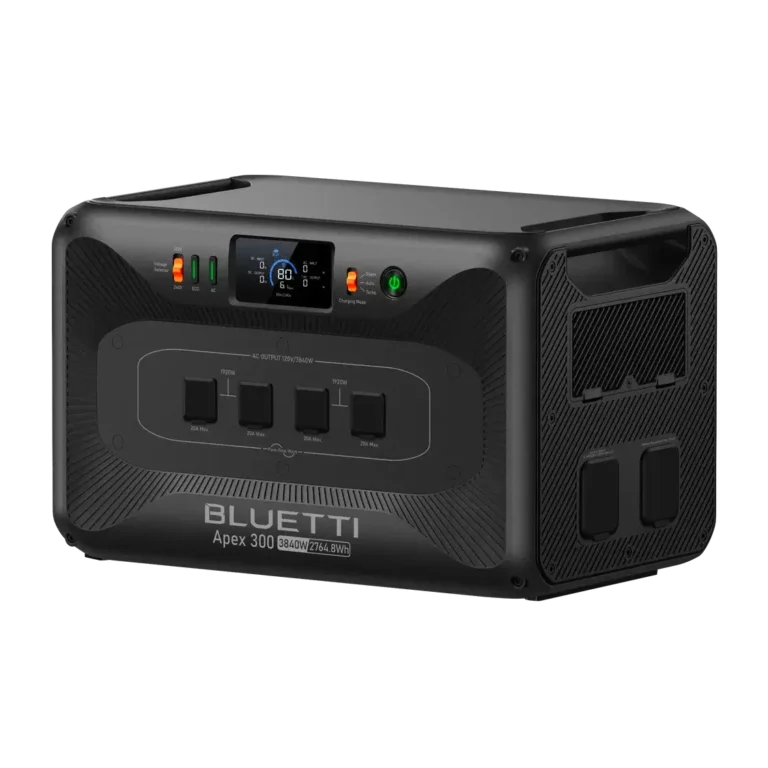
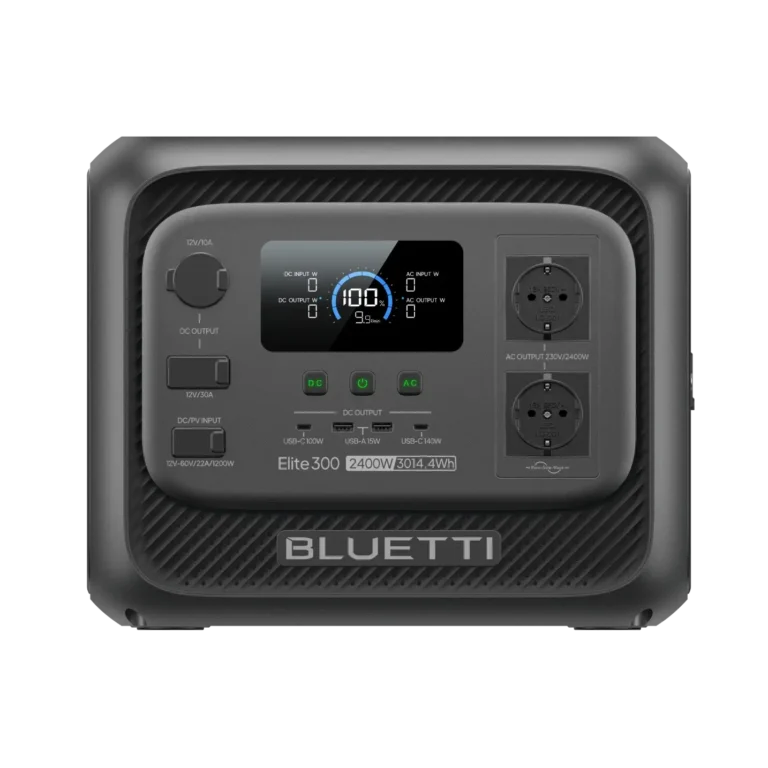
For readers comparing capacity tiers, our BLUETTI Elite 300 review and the Apex 300 battery backup breakdown cover how those higher-capacity models handle the same tradeoff.
Peak continuous wattage, surge capacity, and charge speed sit within the competitive range for the category rather than leading it outright.
The value of the expansion capability is specific to whether capacity needs are expected to grow after purchase, since a fixed 2000Wh alternative has no equivalent path to add capacity later.
For a comparison based purely on immediate specs without expansion, the relevant factors are continuous wattage, surge capacity, charge input speed, and port configuration against a given load profile.
The AC200MAX’s continuous and surge figures place it within the range suitable for the majority of residential and light commercial battery backup scenarios, with the expansion path functioning as additional headroom beyond the base specification.
LiFePO4 packs on the BLUETTI AC200MAX require minimal active maintenance compared to lead-acid alternatives, an important factor for anyone relying on this unit for long-term battery backup, but storage practices still affect long term capacity retention.
BLUETTI’s guidance calls for charging the unit fully before any extended storage period, then topping it back up to 60 to 80 percent state of charge every 3 to 6 months while it sits idle, rather than leaving it at full charge or fully depleted for months at a stretch.
After a long storage period, BLUETTI notes that the pack may need several full charge and discharge cycles before it reports its full rated capacity again, since coulomb counting drift accumulates over time without periodic full-range recalibration events.
Support for simultaneous charge and discharge (pass-through operation) is built in, though the unit should be kept laid flat during charging, discharging, and general use per BLUETTI’s safety guidance.