Physical Address
304 North Cardinal St.
Dorchester Center, MA 02124
Physical Address
304 North Cardinal St.
Dorchester Center, MA 02124

Executive Summary
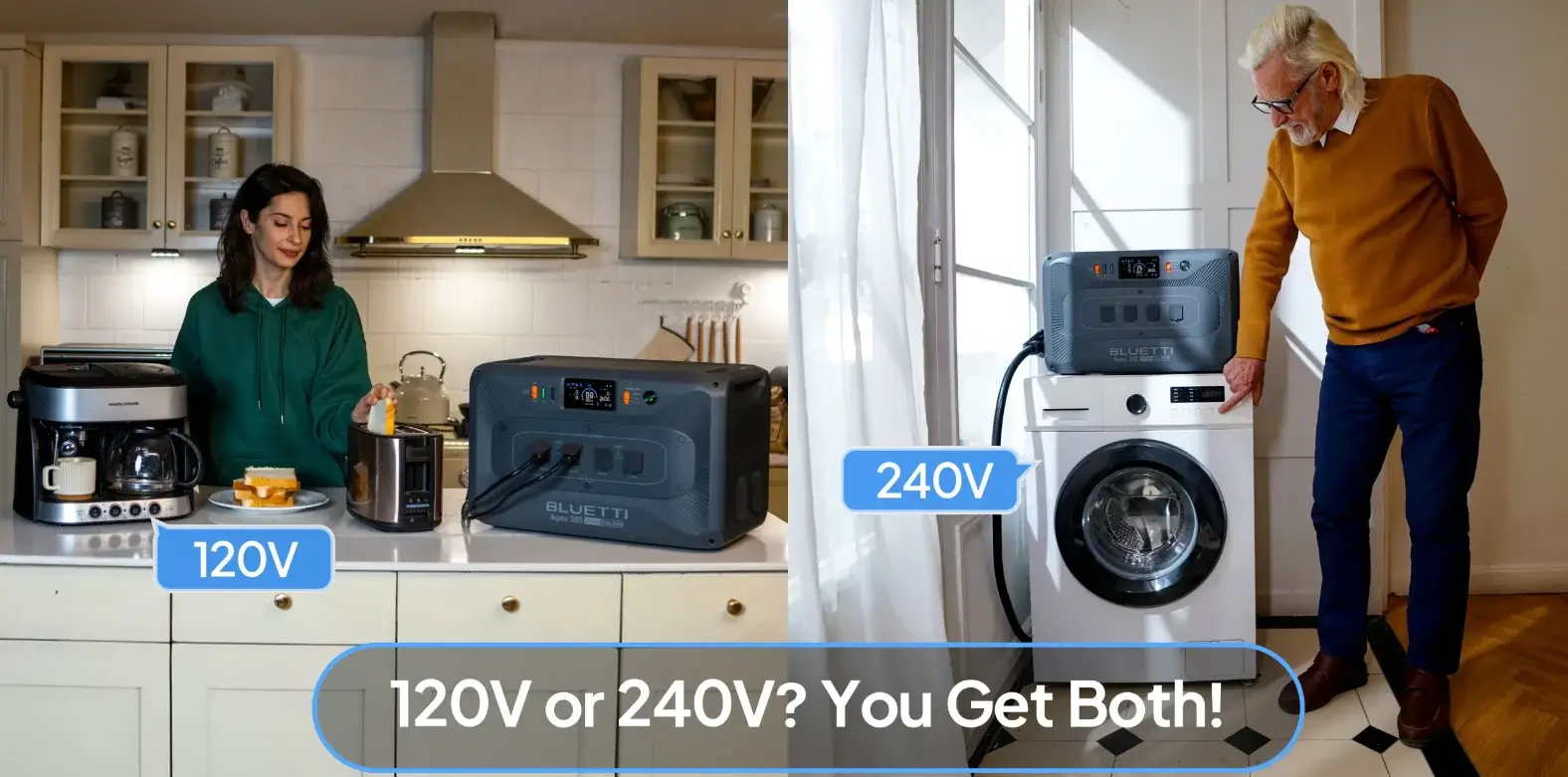
The BLUETTI Apex 300 isn’t just another portable power station. It’s a Home Battery Backup built to grow. Instead of being a single sealed box you buy once and live with, the Apex 300 is designed as the starting point of a bigger home battery system, one you can expand later by bolting on extra battery modules.
This review breaks down its 2764.8Wh LiFePO4 battery, how its power output actually behaves under real household loads, and what you need to know mechanically before you build it into a Home Backup, off-grid, or emergency power setup, including where it will genuinely save you during a blackout, where the trade-offs show up, and where it’ll test your patience.
Quick take
If you want a Home Battery Backup that can start small and expand into a real home backup bank over time, the BLUETTI Apex 300 is one of the few units built for that from day one. If you just want to run a mini-fridge on a camping trip, it’s overkill, and heavy overkill at that.
| Pros | Cons |
|---|---|
| 2764.8Wh LiFePO4 battery rated for 6,000+ cycles to 80% capacity | Heavy at 38 kg; not a grab-and-go unit |
| Expandable to nearly 58kWh and 11.52kW by linking units and battery modules | 12V/USB/Anderson outputs require the separate Hub D1 accessory |
| 3,840W continuous output with 7,680W surge, handles compressor and motor startup loads | Added complexity from WiFi, Bluetooth, and modular bus logic means more that can need a firmware fix |
| Dual MPPT solar input up to 2,400W combined, with active rescanning through the day | 60V-per-channel ceiling on solar wiring can trip up first-time solar installers |
| UPS switching as fast as 0 to 20 ms, no reboot on desktop, router, or CPAP loads | Base unit alone is realistically sized for essential circuits, not a whole house |
| Parameter | Technical Specification |
|---|---|
| Battery Chemistry | LiFePO4 |
| Nominal Capacity | 2764.8Wh (51.2V/54Ah) |
| Cycle Life | 6,000+ cycles to 80% original capacity |
| AC Continuous Output | 3,840 W (Pure Sine Wave) |
| Surge / Lifting Power | 7,680 W |
| AC Input (Charging) | 1,800 W (Bypass capable) |
| Solar Input (MPPT) | 2 × 1,200 W (12–60 VDC, 20 A per channel) |
| UPS Switching Time | 0 to 20 ms, depending on load type |
| Idle Power Draw | As low as 20 W |
| Operating Temp (Charge) | 0°C to 40°C (32°F to 104°F) |
| Operating Temp (Discharge) | -20°C to 40°C (-4°F to 104°F) |
| Connectivity | Wi-Fi & Bluetooth |
| Weight | 38 kg (83.78 lbs) |
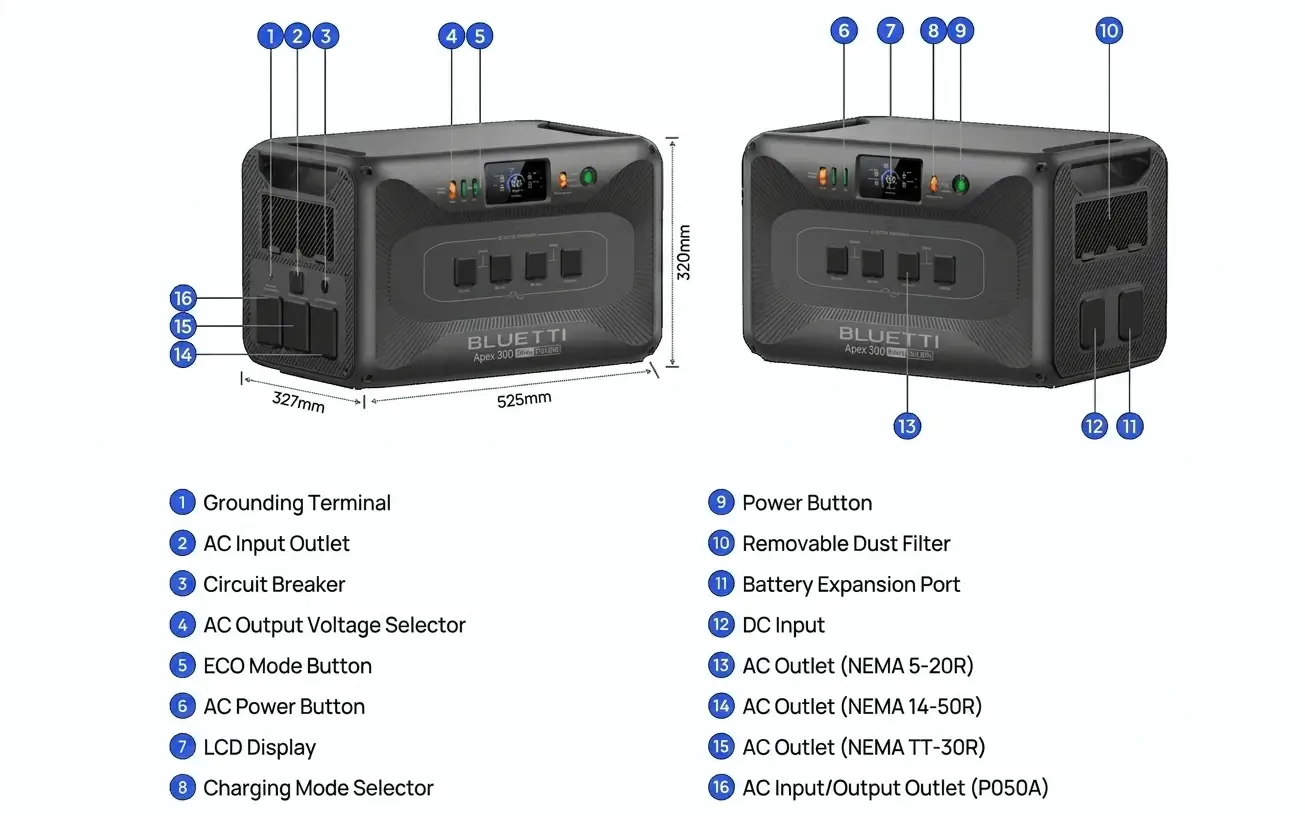
| Dimensions | 525 × 327 × 320 mm |
| Starting Price | $1,699 (base unit) Official Factory Official Factory |
Here’s what’s actually inside the BLUETTI Apex 300, and what each number means once the power goes out at home.
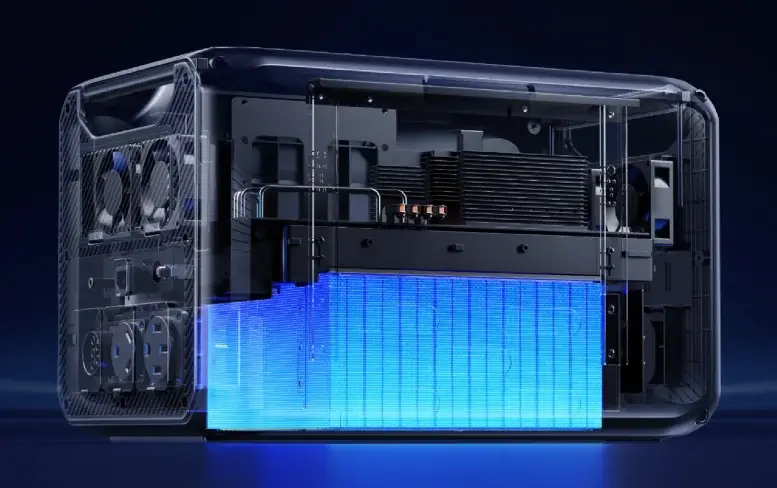
The battery uses LiFePO4 (lithium iron phosphate) chemistry, at 51.2V/54Ah, giving 2764.8Wh of total storage. In plain terms, that’s enough to run a standard fridge for roughly a day and a half on its own, or keep a few lights, a router, and a laptop going for several days straight the kind of runway that makes a real difference for Home Backup during an extended outage.
It’s rated for 6,000+ charge cycles before it drops to 80% of its original capacity. In other words – if you cycle it once a week, you’re looking at well over a decade of realistic use before it noticeably weakens. That’s the main reason LiFePO4 costs more up front than the cheaper NMC batteries you’ll find in budget power stations it degrades much more slowly, which is exactly what you want in a Home Battery Backup you’re relying on for years, not months.
Continuous AC output is 3,840W, with a surge capacity of 7,680W. This distinction matters more than people realize a fridge compressor, a well pump, or a power tool motor can momentarily demand two to three times its running wattage just to kick on. The 3,840W number tells you what it can sustain the 7,680W number tells you it won’t trip and shut off the instant your fridge compressor kicks in.
AC charging input is 1,800W, and solar input is up to 2,400W combined across two independent channels (1,200W each). In other words – on a sunny day, with the right panel setup, you can go from empty to full in a few hours genuinely useful if you’re relying on it during an extended outage with no grid power at all.
UPS switching time is as fast as 0 milliseconds for supported loads, and up to 20 milliseconds depending on the device type. That’s fast enough that a desktop computer, router, or modem won’t even notice the power blip when the grid drops and the Apex 300 takes over, no reboot, no lost work. BLUETTI specifically calls out CPAP machines as a sensitive-load example that stays stable through the switch.
Weight is 38 kg (about 84 lbs). Be honest with yourself here: this is not a grab it and go camping unit. It’s meant to sit in one spot a garage, utility room, or basement as a semi-permanent fixture, not something you’re loading into a car trunk every weekend.
Every LiFePO4 pack needs a brain watching over it, called a BMS (Battery Management System). Here’s what it’s actually doing behind the scenes in the Apex 300, and why it matters to you as the owner rather than as an engineer.
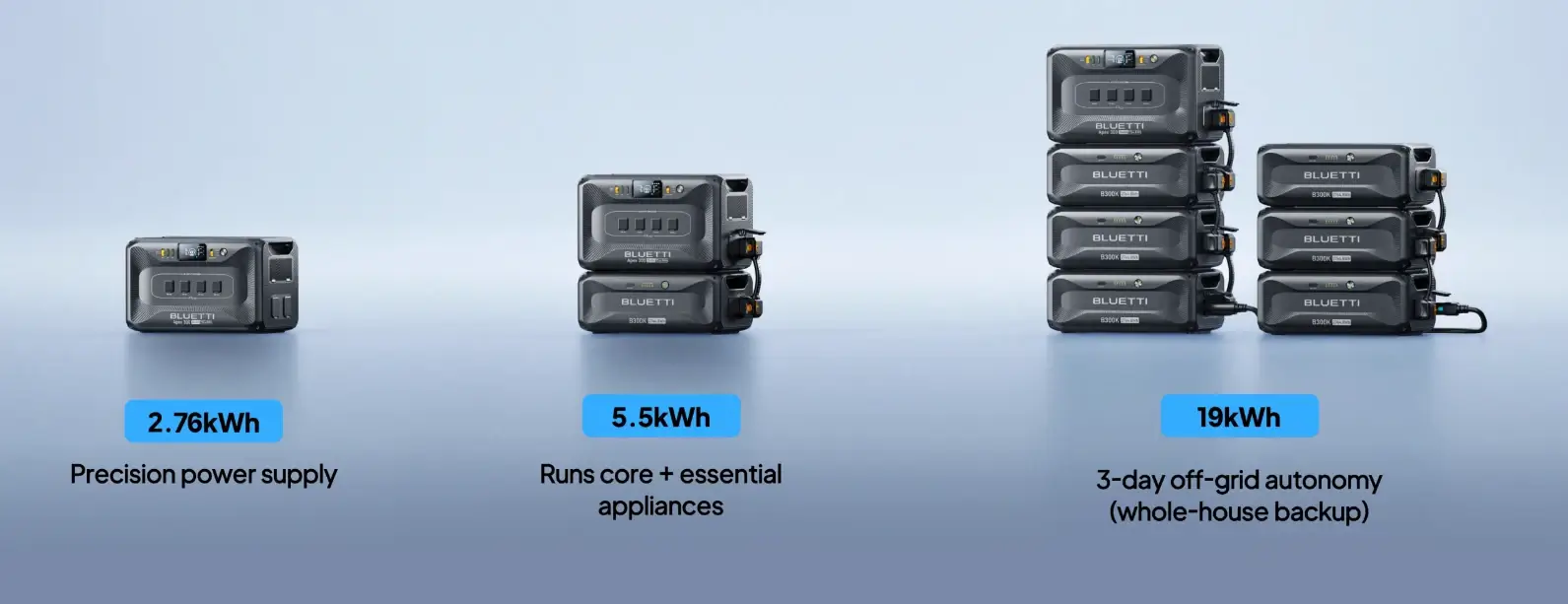
Most power stations are what they are on day one the battery you buy is the battery you keep. The Apex 300 breaks from that with a genuinely large expansion ceiling you can link 2 to 3 Apex 300 units together and add up to 18 external battery modules (B300K or B500K), scaling the system from a 2764.8Wh single unit up to roughly 58kWh, and from 3,840W up to 11.52kW of output.
Adding battery modules or extra units also raises your total system output well beyond the base unit’s 3,840W, up toward the 11.52kW ceiling in the maximum configuration. That matters if you’re pairing it with a large solar array or higher-draw circuits and want to actually use that generation capacity instead of bottlenecking it at the base unit’s limit.
| Configuration | Battery Capacity | Output Power | Realistic Use Case |
|---|---|---|---|
| Base + 1-2 battery modules | Roughly 8-13kWh | 3,840W | Extended runtime for the same essential circuits, longer outages |
| Base unit only | 2764.8Wh | 3,840W (7,680W surge) | Essential circuits: fridge, lighting, internet, a few outlets |
| Multiple units + modules (max config) | Up to ~58kWh | Up to 11.52kW | Whole-home backup, including higher-draw circuits like HVAC |
Instead of just mentioning the power capacity in watts, here is how loads are actually distributed in practice with the Bluetti Apex 300 home integration kit.
| Load Category | Device Type | Est. Power Draw | Operational Note |
|---|---|---|---|
| Peak Load | Heating Elements, Power Tools | 2,000W+ | |
| High Load | Workstations, Heavy Appliances | 600W-2,000W | Constant power draw necessitates thermal management. |
| Low Load | LED Lighting, Routers | < 50W | Near-threshold operation requires full capacity assessment before deployment. |
If you’re planning to pair this with solar panels which is genuinely one of the best reasons to own this unit during a multi-day outage there’s one wiring detail that will save you a support call.
The two MPPT Maximum Power Point Tracking basically the smart circuit that pulls the most possible power out of your panels regardless of sunlight conditions channels each accept 12 to 60 volts DC. Wire your panels in a way that pushes the voltage above 60V which happens if you chain too many panels in a single series string and the unit will shut that input down immediately as a protection measure. This isn’t a flaw it’s the unit protecting itself, but it does mean you need to plan your panel wiring layout before you buy panels, not after.
The practical fix – rather than one long series string, wire your panels in a balanced series-parallel layout to keep voltage comfortably in the 45-55V range while still pulling in the current you need. If you’re not confident designing that layout yourself, this is worth a five-minute conversation with whoever sells you the panels get it wrong and you’ll be capped well below the 2,400W the system is actually capable of.
The MPPT controller also continuously rescans for the best power point as clouds pass over or shade shifts through the day, so you’re not stuck with a fixed, wasteful setting output adjusts on its own throughout the day.
If 2,400W of solar input isn’t enough for your setup, BLUETTI’s optional SolarX 4K controller raises solar input on a single Apex 300 to as much as 4,000W, and up to 19.2kW across a full multi-unit system. It’s a separate accessory rather than something built into the base unit, so it’s worth factoring into your budget if fast solar recharging is a priority rather than a nice-to-have.
Every Home Battery Backup involves trade-offs, and the BLUETTI Apex 300 is no exception. To be fair to anyone considering this purchase, here’s where those trade-offs land, and where the unit isn’t the right fit:
It’s heavy and not portable in any meaningful sense 38 kg means this lives in one spot. If you wanted something to throw in the car for weekend camping trips, look elsewhere this is a stationary home backup unit that happens to be technically portable.
The Hub D1 dependency is a genuine annoyance if you don’t realize it upfront. Finding out after purchase that your 12V or USB outputs need a separate accessory is the kind of thing that generates frustrated reviews so factor that cost and step into your budget from the start.
The added complexity of WiFi, Bluetooth, and modular bus logic means there are simply more components that could theoretically fail or need a firmware fix compared to a simpler, dumb battery box. This is the core trade-off of the Apex 300: you’re giving up some long-term simplicity in exchange for a lot more visibility into what’s happening inside the system a fair trade for most people, but worth knowing it’s a trade at all.
And solar wiring mistakes are genuinely easy to make if you’re new to it the 60V ceiling isn’t intuitive if you’ve never wired panels before, and getting it wrong even though the unit protects itself means a frustrating troubleshooting session before you find out why your solar input isn’t working.
The Apex 300 is backed by BLUETTI’s standard global warranty, with an option to register your unit for a warranty extension.
If a covered issue comes up, BLUETTI also offers an express replacement service rather than the slower repair-and-return process some competitors use, which matters more for a Home Battery Backup than it would for a camping unit, since this is equipment you’re depending on to actually work during an outage. Worth registering the unit and keeping the purchase record handy the day it arrives, not after something goes wrong.
If you want a Home Backup system that starts affordable and grows with you, want solar charging done properly, and don’t mind that it lives permanently in your garage or utility room the BLUETTI Apex 300 is one of the more thoughtfully engineered Home Battery Backup options on the market right now, trade-offs and all.
If you want something you can toss in a car for a weekend trip, or you just need to keep a phone and a couple of lights on during short outages, you’re paying for and lugging around far more capability than you need.
Is the BLUETTI Apex 300 the Right Home Battery Backup for You?
The BLUETTI Apex 300 isn’t trying to be the cheapest or lightest power station on the market. It’s trying to be the one you don’t outgrow.
Between its 2764.8Wh LiFePO4 battery, its expandable bus architecture, and a solar charging system that genuinely holds up under real off-grid conditions, it earns its place as a serious Home Battery Backup rather than just a bigger version of a camping battery pack.
The trade-offs are real and worth weighing honestly – it’s heavy, it depends on the Hub D1 for DC output, and its added smart features mean a bit more complexity than a dumb battery box. None of that is a dealbreaker for the household this is actually built for, but it does mean this isn’t the right pick for weekend campers or anyone just looking for a small, grab-and-go backup.
If your goal is dependable, expandable Home Backup power that can start modest and grow into a real emergency system for your home, the BLUETTI Apex 300 is one of the strongest options currently available and worth the investment.