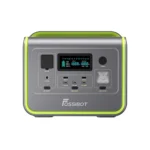
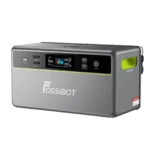
Primary keyword: FOSSiBOT F7200 portable power station
The FOSSiBOT F7200 is the high-capacity model in this group, built around a 5,222.4Wh LiFePO4 battery and a 7,200W maximum AC output. That combination changes the question from “Can it run this appliance?” to “How should a large energy reserve be planned safely?” This guide focuses on that question, using the manufacturer’s published figures and appliance examples rather than generic power-station claims.
Why the F7200 is different
The F7200 is intended for demanding backup and professional-use scenarios. FOSSiBOT lists 7,200W continuous AC output and 9,000W surge power, with expansion to 15,667.2Wh using two FB5222 batteries. It also supports high-voltage and low-voltage solar input, AC plus solar charging, app monitoring and a sub-10ms UPS function. The unit weighs 70kg, so portability means wheels and a pull handle rather than casual carrying.
Maximise Savings, Find Your Ideal Energy Combination
FOSSiBOT lists the F7200 as expandable with compatible FB5222 expansion batteries. The configurations below show storage capacity, not guaranteed financial savings.
| Configuration | Battery Capacity | Expansion Batteries |
|---|---|---|
| F7200 base unit | 5,222.4Wh | None |
| F7200 + 1 × FB5222 | Approximately 10,444.8Wh total | 1 × FB5222 |
| F7200 + 2 × FB5222 | Approximately 15,667.2Wh total | 2 × FB5222 |
Capacity figures are based on the manufacturer-listed base unit and compatible expansion batteries. Usable energy is lower due to conversion losses. Confirm compatibility and installation requirements for your region.
Standard Packing List
Source: FOSSiBOT EU official F7200 product page (“Included In The Box”).
- FOSSiBOT F7200 portable power station (manufacturer lists 70 kg; 670 × 450 × 410 mm)
- AC charging cable (1.5 m)
- MC4-to-XT90 charging cable (1 m)
- Anderson-to-MC4 solar charging cable (1.5 m)
- XT60 car charging cable (1.5 m)
- User manual
- 2 × wrench
- 2 × insulated fork terminal
- 2 × insulated banana plug
This list matches the FOSSiBOT EU page. FB5222 expansion batteries and solar panels are sold separately (solar panels ship separately from the power station) and are not included unless the selected bundle explicitly says so.
Official specifications
| Specification | Official figure |
|---|---|
| Capacity | 5,222.4Wh / 102Ah / 51.2V |
| Battery | LiFePO4 (LF100LA) |
| Lifecycle | 6,500 cycles to 80%+ capacity |
| AC output | 7,200W max. |
| Surge | 9,000W |
| AC input | 3,000W max. |
| High-voltage solar | 2,500W max., 120–450V |
| Low-voltage solar | 1,200W max., 12–55V |
| Combined AC + solar | Up to about 5,200W |
| UPS | <10ms |
| Expansion | Up to two FB5222 batteries, about 15.66kWh total |
| Weight | 70kg |
| Dimensions | 670 × 450 × 410mm |
| AC outlets (EU version) | 4 × 230V pure sine wave |
| USB | 1 × USB-A QC3.0 18W, 1 × USB-C PD 20W, 1 × USB-C PD 100W |
| AC charge time | About 2h 15min at 3,000W |
| Solar charge time | High-voltage 2,500W: about 2h 25min. Low-voltage 1,200W: about 4h 21min. AC + both solar inputs (5,200W): about 1.5 hours |
| Car input (XT60) | 11.5–30V, 10A |
| Pass-through charging | Yes, under 3,000W |
| Operating temperature | Discharging -10 to 40 °C, charging 0 to 40 °C |
| Certifications | FCC, CE, PSE, RoHS, UN38.3, MSDS |
| Warranty | 5 years |
Appliance runtime estimates
The F7200 product page on the FOSSiBOT EU site includes a runtime calculator that uses the appliance wattage and the battery capacity as a reference. The table below gives Lagonzy estimates for the 5,222.4Wh base battery, based on the 4.4–4.7kWh of usable energy that FOSSiBOT quotes. Actual runtime depends on the real load and operating conditions.
This is a practical reference, not a guarantee of runtime, because appliance cycling, temperature and efficiency affect real results.
| Appliance | Typical Power | Estimated Runtime on 5,222.4Wh Base Battery |
|---|---|---|
| Range hood | 200W | 20+ hours |
| Household refrigerator | Intermittent operation | 15–22 hours |
| Small portable air conditioner | 380W | 10–12 hours |
| Small water heater | 1,200W | 3.5–4 hours |
| Coffee machine | 1,800W | 2–2.5 hours |
| Heavy-duty tools, such as chainsaw or circular saw | ~2,400W | 1.5–2 hours |
For essential home loads, FOSSiBOT EU gives approximate backup durations of about 1.5 days on the 5,222.4Wh base unit, about 3 days with one FB5222 (10,444.8Wh) and about 5 days with two (15,667.2Wh). FOSSiBOT’s FAQ also states that usable energy is roughly 4.4–4.7kWh because overall output efficiency is about 85–90%.
Reading the F7200 numbers correctly
The 5,222.4Wh battery describes stored energy; the 7,200W output describes how much AC power the inverter can deliver. These are not interchangeable measurements. A 200W load can be supported for much longer than a 2,000W load, while a high-power appliance still has to remain within the AC output and surge limits. FOSSiBOT’s own calculator on the product page also treats runtime as a reference calculation.
Home backup planning
The F7200 is most useful when loads are prioritized. Refrigeration, networking, lighting and essential electronics can be maintained while high-power cooking or heating loads are used selectively. The large battery reserve gives more flexibility, but it does not make every appliance economical to run continuously. A sensible outage plan separates always-on essentials from short-duration high-power appliances.
Solar and recharge strategy
FOSSiBOT lists 2,500W high-voltage solar input and 1,200W low-voltage solar input. It also publishes combined charging modes reaching approximately 5,200W, 4,000W or 4,200W depending on the solar configuration. The high-voltage input requires compatible solar-array planning, so this is not an area where improvised wiring should be used. Actual solar production depends on sunlight and panel conditions.
UPS and electrical integration
The F7200 has a UPS function with a transfer time under 10ms (up to 3,000W load). FOSSiBOT also describes whole-house use through wiring terminals. That part of the installation is not a casual plug-in task: the manufacturer specifically warns that terminal-based home backup installation requires a licensed electrician. Lagonzy therefore treats the F7200 as a portable energy system first and a home-integration component only when professionally installed.
Who should consider it?
The F7200 makes sense for users who genuinely need a large energy reserve, high continuous output, or expansion capability. It is much less suitable if the main goal is charging phones and laptops on short trips. At 70kg, its physical size is a real trade-off, even with wheels and a retractable handle.
Safety and maintenance
Keep the unit dry, upright and ventilated, use compatible charging equipment, respect the published input ranges, and avoid exceeding the continuous output rating. Inspect cables and connectors before use. Do not open the battery enclosure. For permanent electrical integration, use qualified installation rather than attempting household wiring yourself.
F7200 practical verdict
The F7200 stands out because its capacity and output are both genuinely large. Its strongest use case is extended backup where several appliances must be managed over time, not simply occasional device charging. The runtime estimates are particularly useful because they show the relationship between load size and practical duration. Buyers should compare their real load list against those figures and against the exact regional version available to them.
Specifications and availability can change by product revision or regional listing. Verify the exact version before purchase.