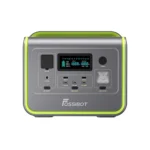
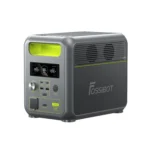
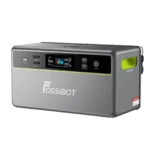
Primary keyword: FOSSiBOT FDC300 portable power station
The FDC300 is fundamentally different from the AC power stations in the FOSSiBOT range. It stores 288Wh but has no AC outlet. Instead, it focuses on efficient DC power through USB-C and USB-A outputs. That makes it particularly suitable for laptops, cameras, phones, lights and other DC equipment rather than household AC appliances.
Standard Packing List
- FDC300 power station (135 × 135 × 205 mm)
- USB-C to USB-C cable
- User manual and warranty card
As listed on the official FOSSiBOT EU product page. No wall charger is listed in the package.
Official specifications
| Specification | Official figure |
|---|---|
| Capacity | 288Wh / 90,000mAh |
| Battery | LiFePO4 |
| Lifecycle | 3,000 cycles to 80%+ capacity |
| USB-A | 1 × 18W max. |
| USB-C | 2 × 140W max. + 1 × 30W max. |
| USB-C input | 140W max. via one port, 200W max. in total via both USB-C ports |
| Solar input | 120W max., 11.5–28V, 8A max. |
| Car input | 120W max., 12V/10A |
| USB-C + solar | 260W max. |
| Weight | 2.66kg |
| Dimensions | 135 × 135 × 205mm |
| Operating temperature | -10 to 40°C |
| Charging temperature | 0 to 40°C |
| Recharge times | USB-C 140W: about 2.28 hours. Two USB-C ports 200W: about 1.6 hours. Solar or car 120W: about 2.67 hours. Two USB-C + solar 260W: about 1.23 hours |
| Built-in fan | Foldable personal fan, 2.3W, up to 100 hours of fan runtime |
| Warranty | 2+1 years |
Full published usage table
| Device / Use | Published Power |
|---|---|
| USB-C device | Up to 140W per port |
| USB-A device | Up to 18W |
| USB-C device | Up to 30W |
| Camera / small gear | DC use |
| Portable light | DC use |
Why the absence of AC is an advantage here
For DC electronics, converting battery energy into AC and then back to DC can add unnecessary conversion losses. The FDC300 avoids that approach for its intended devices. Its dual 140W USB-C outputs are the headline feature for users carrying modern laptops or other high-power USB-C equipment.
Charging options
FOSSiBOT lists several charging routes, including USB-C, solar and car charging. The official EU product page gives approximately 2.67 hours for 120W solar or car recharge under the stated conditions, and approximately 1.23 hours with two USB-C inputs plus solar at the published combined limit. Solar timing depends on sunlight and panel orientation.
Who should buy it?
The FDC300 is a strong fit for photographers, students, travelers, campers and anyone who primarily needs DC power. It is not the right tool for a kettle, hair dryer or household coffee machine because it has no AC outlet.
Runtime planning
With 288Wh available, runtime depends directly on the DC device’s consumption. A laptop drawing 60W is fundamentally different from a 140W USB-C load. Because the unit avoids an AC inverter, users should evaluate the actual charger or device input rather than relying on generic AC runtime calculators.
Port management
The FDC300 can support multiple devices, but the maximum combined input/output figures still matter. Use the correct USB-C ports for high-power devices and avoid assuming that every port can deliver the maximum simultaneously without checking the product’s combined-output limits.
Safety and maintenance
Keep the unit dry, protect the ports from debris, use compatible cables and respect charging-temperature limits. Do not attempt to add an AC inverter internally. FOSSiBOT advises that the unit cannot be taken on a passenger aircraft, because its 288Wh battery exceeds the usual 160Wh limit. The product is designed as a DC station and should be used that way.
Final assessment
The FDC300 succeeds by being specific. At 2.66kg and 288Wh, it is far easier to carry than a full AC power station, while its 140W USB-C outputs are substantially more capable than a typical phone power bank. Its lack of AC is not a missing feature for its intended audience; it is part of the design.